Route: [Visa-free] Rio de Janeiro, Brazil Day Trip: Visit Christ the Redeemer (by train) + Sugarloaf Mountain + Maracanã Stadium + Cathedral + Serralon Steps + BBQ Buffet Lunch (English-speaking tour) [ Latin America ]
D1 Rio de Janeiro Meeting Point: Tour start time: 08:00 Tour start location: Round-trip pick-up service provided by major hotels in the South (Copacabana, Ipanema, Leblon, Leme) and West (Barra da Tijuca) areas.
D1 Rio de Janeiro
Outline: Rio de Janeiro
Note:
Children (3-10 years old) €70
Translation
Disclaimer:
This website has been translated into English using machine translation for your convenience. Please note that machine translations may contain inaccuracies or errors and are intended for general understanding only. The original Chinese version is the official version. In case of any discrepancies, the Chinese version shall prevail.


none
2 Pick-up Locations
Air-conditioned Coach/Van
Meals Refer to the itinerary for meal details
English Speaking Guide
Not Applicable
 Important Notes:
Other information:
Daily departure. 8:00 AM departure. Trip duration: 8 hours.
• Provides round-trip shuttle service to major hotels in the South (Copacabana, Leme, Ipanema, Leblon) and West (Barra da Tijuca) areas.
• We do not provide pick-up and drop-off services for hostels or guesthouses. Guests staying in hostels or guesthouses will be informed of the pick-up time and the nearest hotel as the meeting point.
Hotel pick-up and drop-off service begins before the event starts.
Guests not staying at a beachfront hotel will be informed of the nearest pick-up location and time.
Please contact us to confirm your pick-up time.
Children must be accompanied by an adult.
Children aged 2 and under are free, provided they do not occupy a seat.
The maximum number of people in this group is 46.
Note: The times shown above only serve as recommendations. The actual arrival time may be delayed due to a variety of force majeure circumstances, including bad weather, gridlock, accidents, festivals, events, riots, strikes, etc. We apologize about that. If you have other trip plans and need to take other transitions to get to other cities, please reserve at least three hours of extra time so as to avoid any issues with delayed travel. If you fail to arrange enough time while planning your trip, our company will not take into account any losses you encounter. We appreciate your understanding.
Sugarloaf Mountain is a famous landmark in Rio de Janeiro, named for its resemblance to a loaf of bread. Located at the entrance to Guanabara Bay, it is one of Rio de Janeiro's symbols. Sugarloaf Mountain is approximately 400 meters high and consists of two peaks, one resembling a horizontal loaf and the other an upright loaf. From the top of Sugarloaf Mountain, one can overlook the city and the entire Guanabara Bay, and also see Christ the Redeemer statue, Copacabana Beach, and Rodrigo Atoll in the distance.
Maracanã Stadium (Portuguese: Estádio do Maracanã) is one of the most iconic and historic football stadiums in the world, located in Rio de Janeiro, Brazil. Originally built for the 1950 FIFA World Cup, it was once the largest stadium in the world, capable of holding nearly 200,000 spectators. The Maracanã has hosted numerous major international events, including the FIFA World Cup, the Olympic Games, and the Copa América. It has served as the home ground for the Brazilian national team and top Rio-based football clubs like Flamengo and Fluminense. During the 2014 FIFA World Cup and the 2016 Rio Olympics, the stadium once again drew global attention. After multiple renovations, it now has a seating capacity of around 78,000 and remains a symbol of Brazilian football and sports culture worldwide.
The Sambadrome (Portuguese: Sambódromo da Marquês de Sapucaí) is a purpose-built parade area in Rio de Janeiro, Brazil, designed for the city's world-famous Carnival samba parades. It was completed in 1984 and designed by renowned architect Oscar Niemeyer. The venue is about 700 meters long and has grandstands on both sides, accommodating tens of thousands of spectators. Each year in February or March, the Sambadrome becomes the vibrant stage for Rio’s top samba schools to compete in colorful, high-energy performances. It is a powerful symbol of Brazilian culture and the spirit of Carnival.
The Metropolitan Cathedral of Rio de Janeiro, officially named the Cathedral of Saint Sebastian, is one of the most important Catholic churches in Brazil. Located in Rio de Janeiro, it was built between 1964 and 1979 and features a striking modernist design inspired by Mayan pyramids. The building stands about 75 meters tall and can hold up to 20,000 people. Inside, the cathedral is marked by simplicity and grandeur, with four massive stained-glass windows reaching 64 meters high. The natural light that filters through creates a solemn and awe-inspiring atmosphere. It serves as both a religious center and a popular tourist attraction.
The Selarón Steps (Portuguese: Escadaria Selarón) are a famous set of colorful mosaic stairs in Rio de Janeiro, Brazil, created by Chilean-born artist Jorge Selarón. The steps connect the neighborhoods of Lapa and Santa Teresa, with a total of 215 steps stretching about 125 meters. Starting in 1990, Selarón began decorating the stairs with brightly colored tiles, eventually transforming them into a vibrant public artwork. The tiles come from over 60 countries, making the steps a unique symbol of multiculturalism and artistic passion.
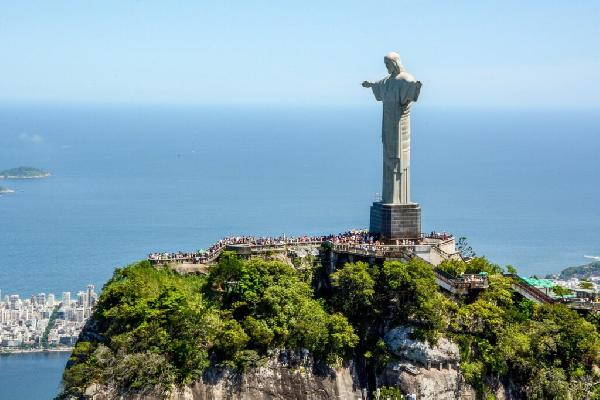
Christ the Redeemer Statue (Portuguese: Cristo Redentor) is one of the most iconic landmarks in the world, located atop Mount Corcovado in Rio de Janeiro, Brazil. The statue stands approximately 30 meters (98 feet) tall, excluding its 8-meter (26 feet) pedestal, and its outstretched arms span 28 meters (92 feet). It was completed in 1931 and was designed by French sculptor Paul Landowski, with construction overseen by Brazilian engineer Heitor da Silva Costa. The statue is made of reinforced concrete and covered in thousands of triangular soapstone tiles. Christ the Redeemer is a symbol of Christianity and peace, representing Jesus Christ’s love and protection for humanity. It also reflects the religious devotion and cultural identity of the Brazilian people. Recognized as one of the New Seven Wonders of the World, it draws millions of visitors each year and remains a powerful symbol of faith and hospitality in Brazil.
The fee includes:
The fee does not include :
• Full refund available if cancelled 24 hours or more before departure.
No refunds will be given for cancellations made within 24 hours of departure.
Questions previously answered may have different answers due to many reasons: season (date and year of travel), rates, availability, etc. Please contact us for more information. Online Chat

 020-6200004
